

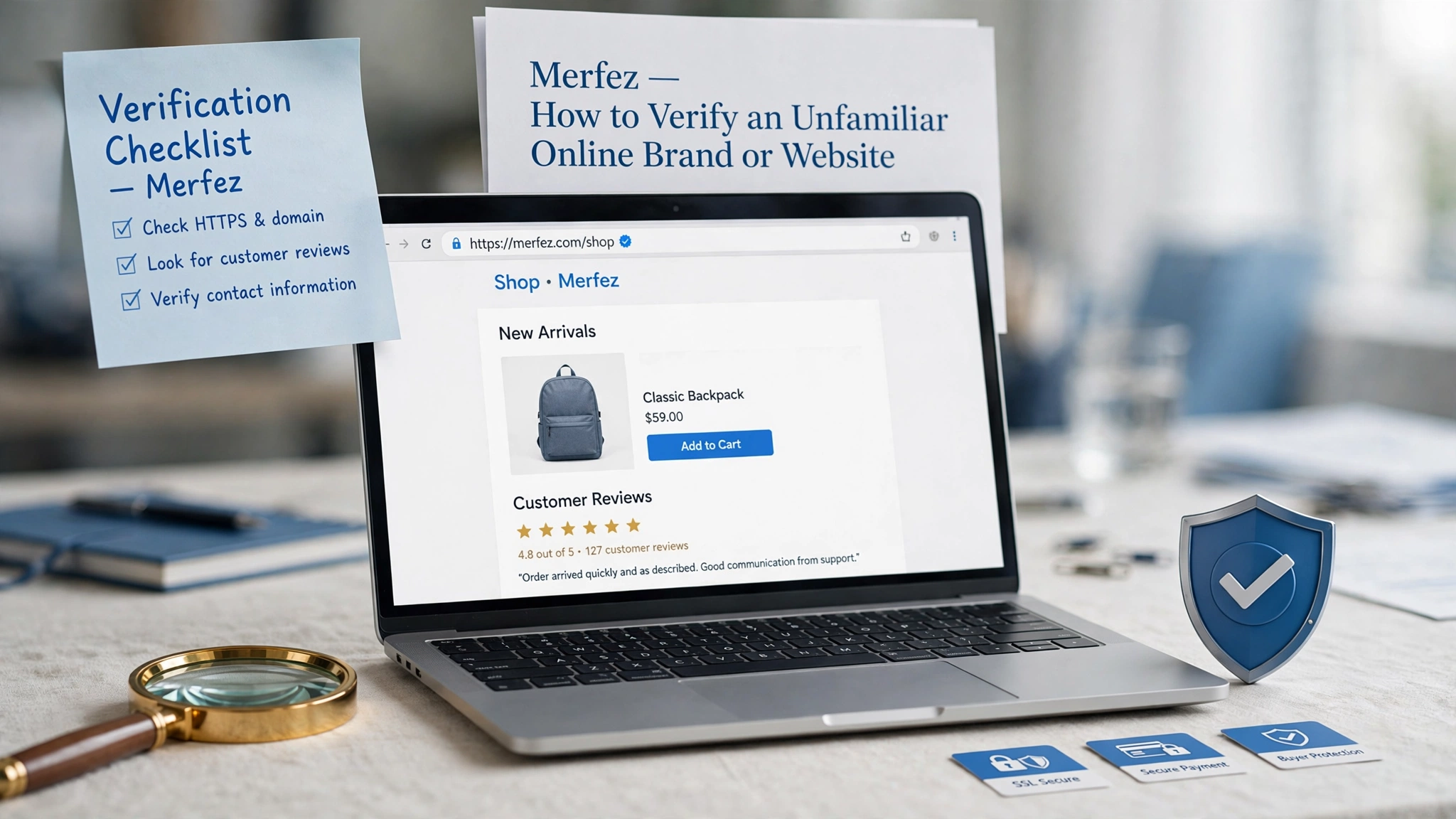
When a brand or website is unfamiliar, the safest approach is to verify its identity, reputation, products, contact details, and payment practices before sharing personal information or placing an order. Merfez should be evaluated through verifiable information rather than assumptions based on its name or appearance.
For people searching for Merfez, the most useful question is not simply “What is it?” but “How can I determine whether this is the right website, business, product, or service I am looking for?” That distinction matters because unfamiliar brand names can belong to different businesses, domains, products, or online services.
Start by identifying exactly which Merfez you found
The first step is to establish the entity behind the name.
Check the exact spelling, website address, social-media profile, product name, and company information associated with the result. A familiar-looking logo or domain name does not establish that a website is legitimate.
Look for these identifiers:
- Official website domain
- Legal business name
- Physical business address
- Customer-service email and telephone number
- Company registration details, where applicable
- Social-media accounts that link back to the same domain
- Product or service information
- Terms and conditions
- Privacy policy
- Refund or cancellation policy
A genuine business should provide enough information for customers to understand who operates the service and how transactions are handled.
Why the exact domain matters
Search results can contain similarly named websites. One misplaced letter in a domain can send a visitor to an entirely different business.
Before entering payment information, manually check the domain in the browser address bar. HTTPS is necessary for secure transmission, but HTTPS alone does not prove that a website is trustworthy. Scam websites can also use encrypted connections.
Check whether the business information matches
A useful verification method is consistency.
Suppose a Merfez website lists a company address in one country but its contact page, payment information, and legal documents identify a completely different business. That inconsistency deserves investigation.
Compare information across:
| Verification point | What to check |
|---|---|
| Website | Exact domain and company identity |
| Contact page | Email, phone number, and address |
| Legal pages | Terms, privacy policy, refunds |
| Social profiles | Consistent branding and links |
| Business directories | Name and address consistency |
| Reviews | Patterns rather than isolated comments |
| Payment page | Available payment methods and merchant name |
One matching detail proves little. Several independently matching details provide much stronger evidence.
Look beyond star ratings
Online reviews can help, but a high rating should not be treated as proof of legitimacy.
Read individual reviews and look for specific experiences. Useful reviews usually mention details such as delivery times, product quality, customer support, returns, billing, or how a problem was resolved.
Be cautious when reviews are:
- Extremely similar in wording
- Concentrated within a short period
- Vague and lacking product details
- Excessively positive without explaining why
- Contradictory about the business being reviewed
Negative reviews also need context. A handful of complaints does not automatically make a business fraudulent. Established companies can receive legitimate complaints, particularly about shipping delays or customer service.
The better approach is to identify patterns.
For example, if multiple unrelated customers describe the same unexplained charge, missing order, or refusal to honor a published refund policy, that pattern is more significant than a single one-star review.
Check the payment process before buying
Payment methods provide another useful verification point.
A legitimate online store can use different payment providers, so the presence of a particular payment method is not itself a guarantee. What matters is whether the checkout process clearly identifies the merchant and provides appropriate transaction protections.
Before paying, verify:
- The checkout page belongs to the expected domain or a clearly identified payment provider.
- The final price matches the advertised price.
- Shipping, taxes, and other charges are visible before payment.
- The merchant or business name is identifiable.
- The refund and cancellation conditions are accessible.
- The transaction does not require unnecessary personal information.
Avoid sending money through an irreversible method simply because a seller offers a discount for doing so.
Examine the product or service claims carefully
If the search relates to a Merfez product, evaluate the actual offer rather than relying on promotional language.
A strong product listing explains what the product is, what it includes, its specifications, pricing, delivery information, and applicable warranty or return terms.
For technology products, useful specifications include:
- Model number
- Dimensions
- Compatibility
- Materials
- Power requirements
- Included accessories
- Warranty information
For services, look for:
- Scope of work
- Pricing structure
- Contract terms
- Delivery timeframe
- Cancellation conditions
- Customer-support channels
Specific information makes an offer easier to verify. Vague claims such as “premium,” “guaranteed,” or “best quality” provide little evidence on their own.
A practical Merfez verification example
Imagine you discover a previously unknown online store while searching for a particular product. The site has attractive prices and professional-looking images, but you have never heard of the company.
Instead of ordering immediately, spend 10 minutes checking five things:
First, confirm the domain and business name.
Second, inspect the contact, privacy, refund, and terms pages.
Third, search for independent customer experiences using the exact business or domain name.
Fourth, compare the listed company information with independent business records or established platforms where appropriate.
Fifth, inspect the checkout page and payment conditions before entering financial information.
If those checks produce consistent information, you have substantially more evidence than you would get from the website design alone.
If the checks reveal contradictory addresses, copied-looking policies, unusual payment requests, or a complete absence of credible business information, stop and investigate further.
Common mistakes when evaluating an unfamiliar website
Trusting a professional design
Modern website templates make it easy for almost any organization to create a polished storefront. Design quality is therefore a weak indicator of business legitimacy.
Assuming HTTPS means the company is legitimate
HTTPS protects the connection between your browser and the website. It does not verify the identity or reputation of the business operating that website.
Relying on one review platform
A single platform can provide an incomplete picture. Compare independent sources and look for recurring experiences.
Focusing only on price
An unusually low price can be attractive, but price should be evaluated alongside product specifications, shipping terms, refund policies, and seller identity.
Entering personal information too early
There is rarely a reason to provide sensitive information before you understand who operates a website and why the information is required.
What information should you verify before creating an account?
Account creation deserves the same scrutiny as purchasing.
Before registering, determine why the service requires an account and what information it collects. Review its privacy policy for details about data collection, storage, sharing, and account management.
Use a unique password rather than reusing the password from your email, banking, or other important accounts. If the service supports multi-factor authentication, enable it.
Do not provide information that is unrelated to the service simply because a registration form requests it.
When should you walk away?
Some warning signs deserve immediate attention.
Walk away from a transaction when the seller:
- Pressures you to pay immediately
- Refuses to explain who operates the business
- Requests payment through an unusual irreversible method
- Provides contradictory company information
- Makes claims that cannot be independently verified
- Has unclear refund or cancellation conditions
- Requests unnecessary sensitive information
- Changes the price unexpectedly during checkout
No single warning sign establishes that a business is fraudulent. Several unresolved warning signs together justify avoiding the transaction.
The simplest way to evaluate Merfez
Treat an unfamiliar name as an identity-verification task first and a purchasing decision second.
Search the exact name, confirm the domain, identify the operating business, compare its contact information, examine independent customer experiences, and understand the payment and refund terms. Those steps take relatively little time and produce much better evidence than judging a website by its appearance.
If you are specifically trying to identify a particular Merfez website, product, or company, use the exact domain or product URL as the starting point. That removes ambiguity and makes it possible to evaluate the specific entity rather than a similarly named business.
